A diesel Harley-Davidson?
Between an electric transition and a hydrogen revival, passing through temporary bubbles such as LPG, biofuels occasionally return to the headlines.
This is how a category of fuels is defined, scientifically divided into two schools of thought.
On the one hand, first-generation fuels, obtained from biomass that resembles the recipe for a vegan minestrone:
- wheat,
- corn,
- beetroot,
- sugar cane,
- palm oil.
On the other hand, more advanced fuels, derived from food waste, used oils and organic waste.
While the former have never been entirely convincing, because producing them means sacrificing too much land for crops needed for the food chain, the latter are more appealing because they also offer a solution to another very topical problem: waste.
Yet, according to data from IFP Énergies Nuovelles, in 2023 biodiesel accounted for only 4.8% of road fuels used worldwide.
Alex’s idea
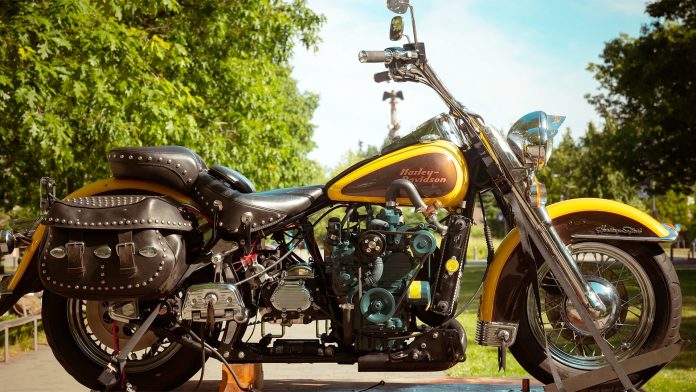
Alex Jennison, a student at the University of British Columbia, has memorised these facts so well that he has decided to put his name and face to an experiment that currently seems to be unrivalled in the world: equipping an Harley-Davidson with a diesel engine capable of running on used cooking oil.
The goal: to give a new boost to biofuels derived from food waste, ready for use and without any need for infrastructure, charging stations or rare earths, and perhaps for this very reason too quickly forgotten in the name of new sources of profit.

Alex, like the famous ants in their own small way, helped by a small group of friends and classmates, chose a 1999 Heritage Softail.
One of the Custom road models produced by the Milwaukee brand since the mid-1980s, the last one with a separate engine and gearbox, a detail that would simplify the modification.
A small agricultural diesel engine
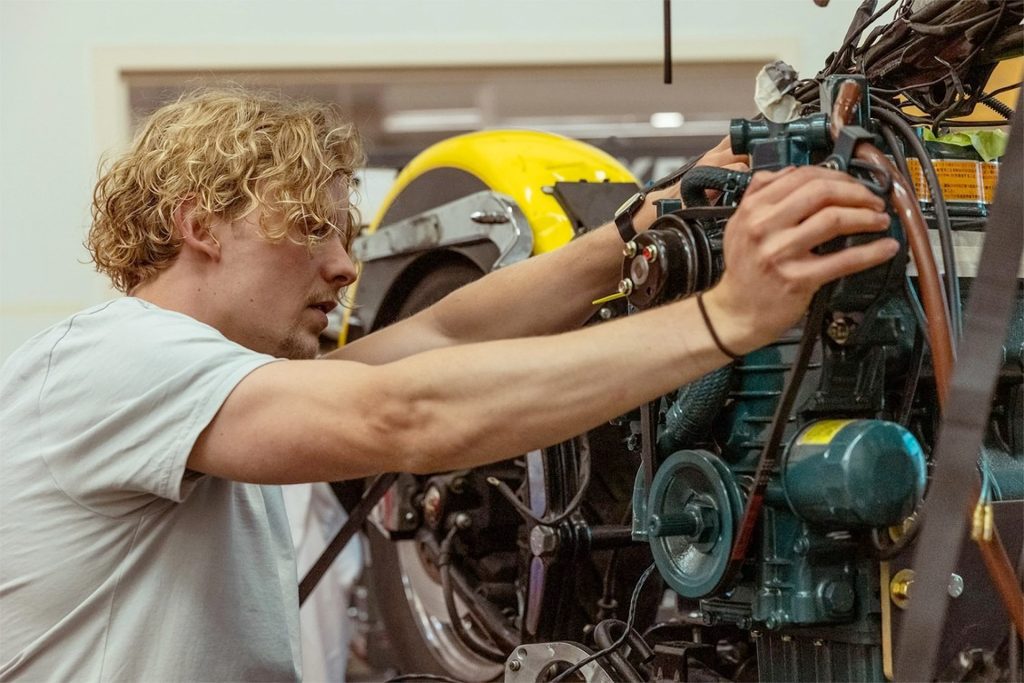
Instead of the 1,450 cm3 Twin Cam 88, the team chose to fit a water-cooled, three-cylinder vertical Kubota D902-T.
This unit is a compact engine equipped with a turbocharger and no particulate filter, designed for small agricultural or work vehicles.
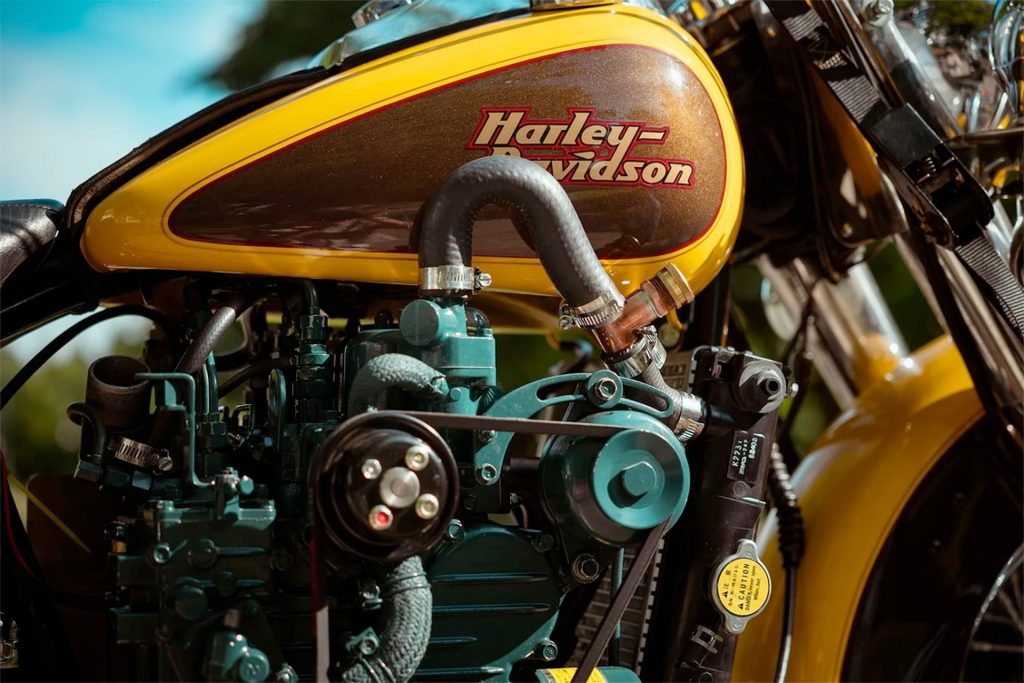
The operation was not simple, and it took many months of work to develop a replacement that would allow the most legendary of American motorcycles to run on biodiesel.
It is produced from used vegetable oil subjected to a simple chemical process, as is done on many farms.
In all fairness, it must be said that Alex Jennison’s Heritage Softail is not a zero-emission motorcycle.
But the operation has reduced carbon dioxide emissions by a comforting 74% compared to a normal diesel engine.
A demo trip
Alex is currently travelling across the United States, on a carefully planned coast-to-coast trip that will take him to around fifteen dealerships, ten universities and several towns.
At each stop, Alex talks about his project, explains how the world unfairly ignores biodiesel, reminds people that companies pay to dispose of used oil and, above all, shows everyone his Harley-Davidson.
Just before disappearing into the sunset, leaving behind the unmistakable smell of chips.
It may make you think, but to begin with, it whets your appetite.