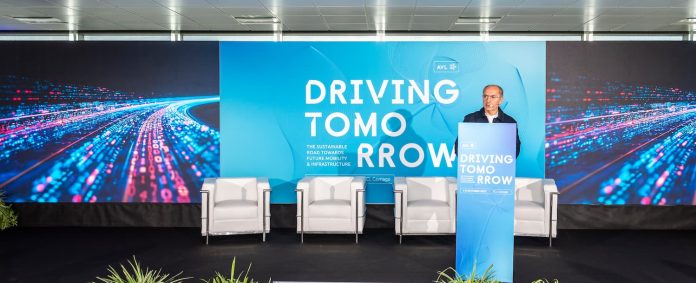
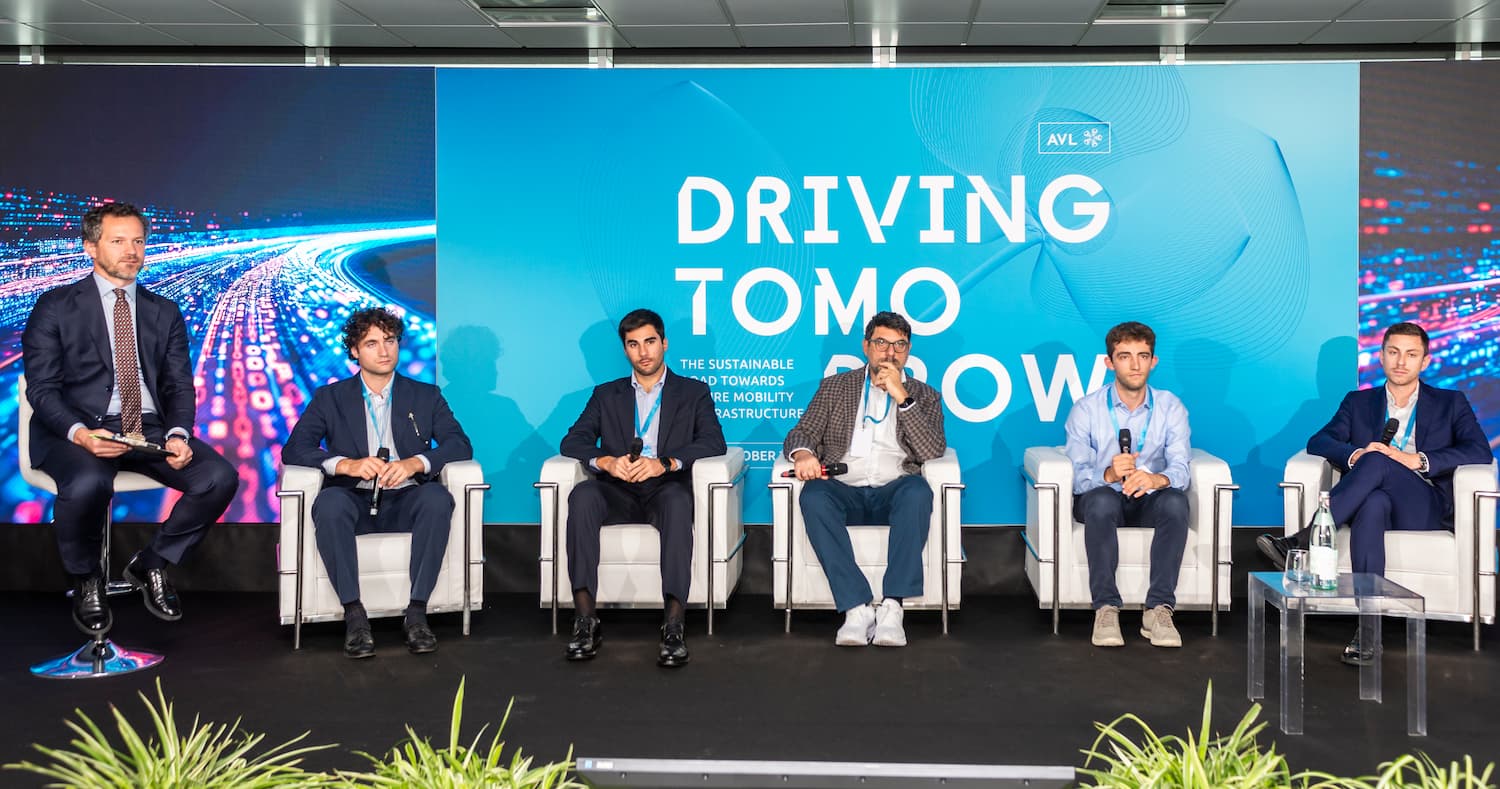
The conference ‘Driving Tomorrow: The Sustainable Road Towards Future Mobility & Infrastructures’, has been organised by AVL Italia, a company specialising in technological solutions and powertrain systems for sustainable mobility in the automotive, railway, maritime and energy sectors.
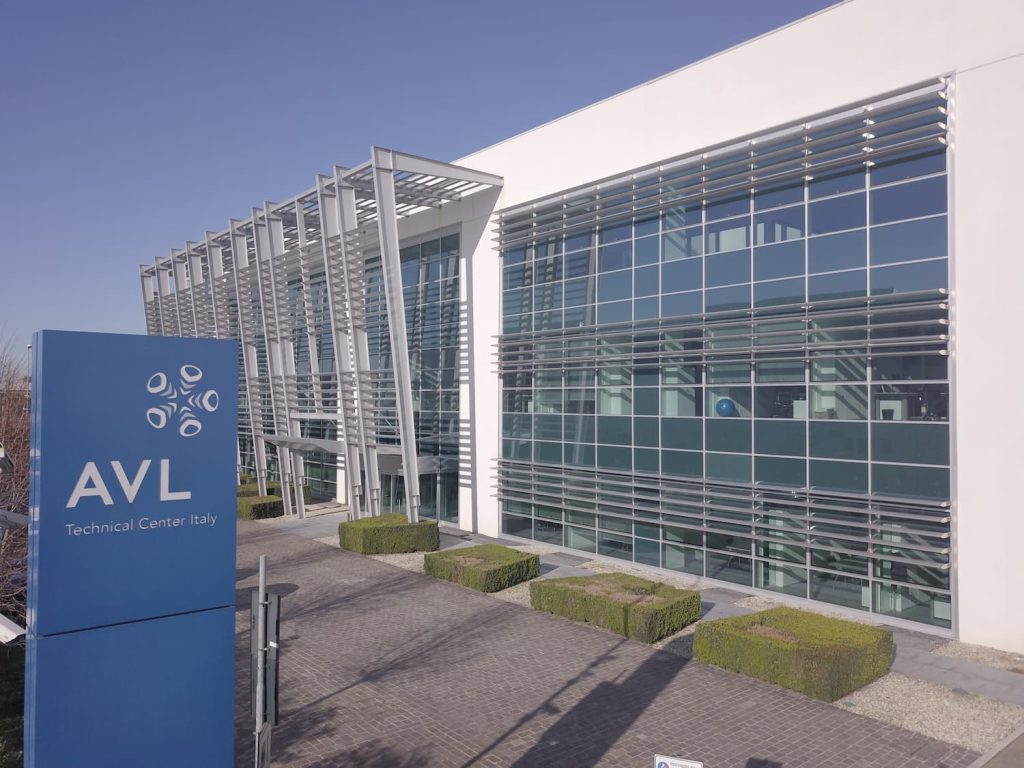
It was hosted at the AVL Italia Technical Centre in Cavriago, and splitted into two sessions.
The first, dedicated to the transformation towards the vehicle of 2050, focused on the new generation of intelligent transport interconnected with mobility infrastructures, in which powertrains, components and software work together in an integrated manner.
The second session shifted the focus from vehicles to sustainable infrastructure and energy systems, based on the assumption that energy-intensive centres and industrial areas must integrate renewable energies, smart grids and new fuels such as green hydrogen to become self-sufficient ecosystems.
Driving Tomorrow with experts and professionals from the industrial and academic worlds
The event focused on identifying the most significant trends in the automotive engineering sector, broadening the perspective to include technological developments in infrastructure, on which the implementation of mobility solutions for the near future depends.
The event provided an opportunity for companies and institutions facing similar issues from different perspectives to engage in dialogue, with the aim of creating synergies and accelerating convergence on certain critical processes.
Driving Tomorrow guests had the opportunity to communicate their research activities and obtain feedback from the scientific and industrial community, including on innovations such as the use of artificial intelligence and the transition to green hydrogen.
Dino Brancale, CEO of AVL Italia
“The primary objective of our initiative is to guide market operators through the process of transforming mobility, which today is no longer just about vehicles but also infrastructure”.
“In fact, demand for new vehicles cannot exist unless it is accompanied by infrastructure upgrades”.
“In this regard, we believe that hydrogen will play a key role, because it is also a vector for energy storage”.
“The other goal is to create synergy between the experiences of different sectors, including energy, infrastructure and powertrain”.
“Combining these skills and creating a system drives innovation forward”.
“As a technology provider, we are already in the future, and we are all building tomorrow together”.
First session: the 2050’s vehicle
2050 is the horizon to look towards for many mobility objectives, both in terms of environmental impact and safety and comfort.
- Gianluca Frigerio (Vehicle Dynamics Lead Engineer at Dallara),
- Nicola Amati (Full Professor at the Polytechnic University of Turin),
- Mario Oswald (Skill Team Leader Virtual Vehicle at AVL List),
- Marco Pagliari (Technical Manager at CETOC TS),
emphasised that the time to market for research (TTM) has shortened, partly due to the increasingly stringent demands of Generation Z, often linked to infomobility.
Today, R&D departments are called upon to accelerate processes to deliver new technologies within 12-18 months, compared to the 48-60 months required until a few years ago.
One of the most notable innovations is the electrification of aerodynamic and suspension systems, which aims to overcome current passive system technology by evolving towards active systems.
At present, the solutions on offer are very expensive and consume a lot of electrical power.
The goal is to overcome these barriers by using solutions with reduced energy consumption, such as those that recover energy during certain phases of motion.
An additional advantage is that many of these systems are based on control logic that takes into account vehicle ageing and can be updated remotely to improve component utilisation throughout their lifetime.
In general, the vision that emerged was one of exponential technical evolution, in a context marked by the boom in vehicles from China.
AI and other digital technologies represent an accelerator towards new solutions that will enable European industry to remain competitive, even in relation to other trends such as autonomous driving.
Second session: sustainable infrastructure and energy systems
This session was introduced by Alessandro Costa (General Director of the Venice Sustainability Foundation), who highlighted Venice’s role as an enabler of sustainable transformations to improve quality of life in all its forms (economic, social, environmental and even cultural).
The lagoon city is, in fact, a magnet and showcase for innovations and best practices related to the various transitions taking place globally, starting with the use of AI and hydrogen.
On the one hand, the solutions tested in Venice can be applied in any other context, and on the other, partnerships with companies can provide a response to the major problems facing the Venetian territory, such as tourist overload and residential depopulation.
The session on infrastructure continued with presentations by:
- Nicolas Posa (Hydrogen Technical Services Specialist, Edison Next),
- Andrea Rigon (Hydrogen Business Development Manager Pietro Fiorentini),
- Riccardo Colotti (Innovation Analyst Fincantieri),
- Domenico Di Canosa (EMEA Sales Director J2 Innovations),
who focused on the prospects for the implementation of hydrogen and digital technologies such as AI, IoT and digital twins in energy flow management.
Improving hydrogen conversion and generation technology
This is the key to reducing the price of this energy carrier, whose use in mobility will only become feasible if the cost falls from the current €9/kg to €4.5/kg.
Hydrogen-driven decarbonisation, not only in mobility but also in “hard-to-abate” sectors, is already a reality for Edison Next, which recently inaugurated the first refuelling stations at Malpensa Airport.
Edison next also presented the world’s first ceramic tile made using green hydrogen, in collaboration with Iris Ceramica Group, and plans to complete the Puglia Green Hydrogen Valley between Taranto and Brindisi by 2030.
Pietro Fiorentini has also made an important contribution, developing an innovative system for producing hydrogen through electrolysis.
The transition also affects maritime mobility
At Driving Tomorrow, simulation models of energy flows on board cruise ships implemented by Fincantieri were presented.
These offer advantages in both ship design and management.
Thanks to these models, customers can improve the selection, operation and functioning of machinery, as well as optimise consumption.
In general, in the context of an increasingly complex and multidirectional network, digitalisation facilitates energy governance and energy flow management.
AI is an actuator that allows users’ energy needs to be managed and predicted, cross-referencing them with the possibilities for producing and managing energy.
The aim is to multiply the effects of the energy transition and the role of renewable sources in new energy systems, using as little energy as possible.